
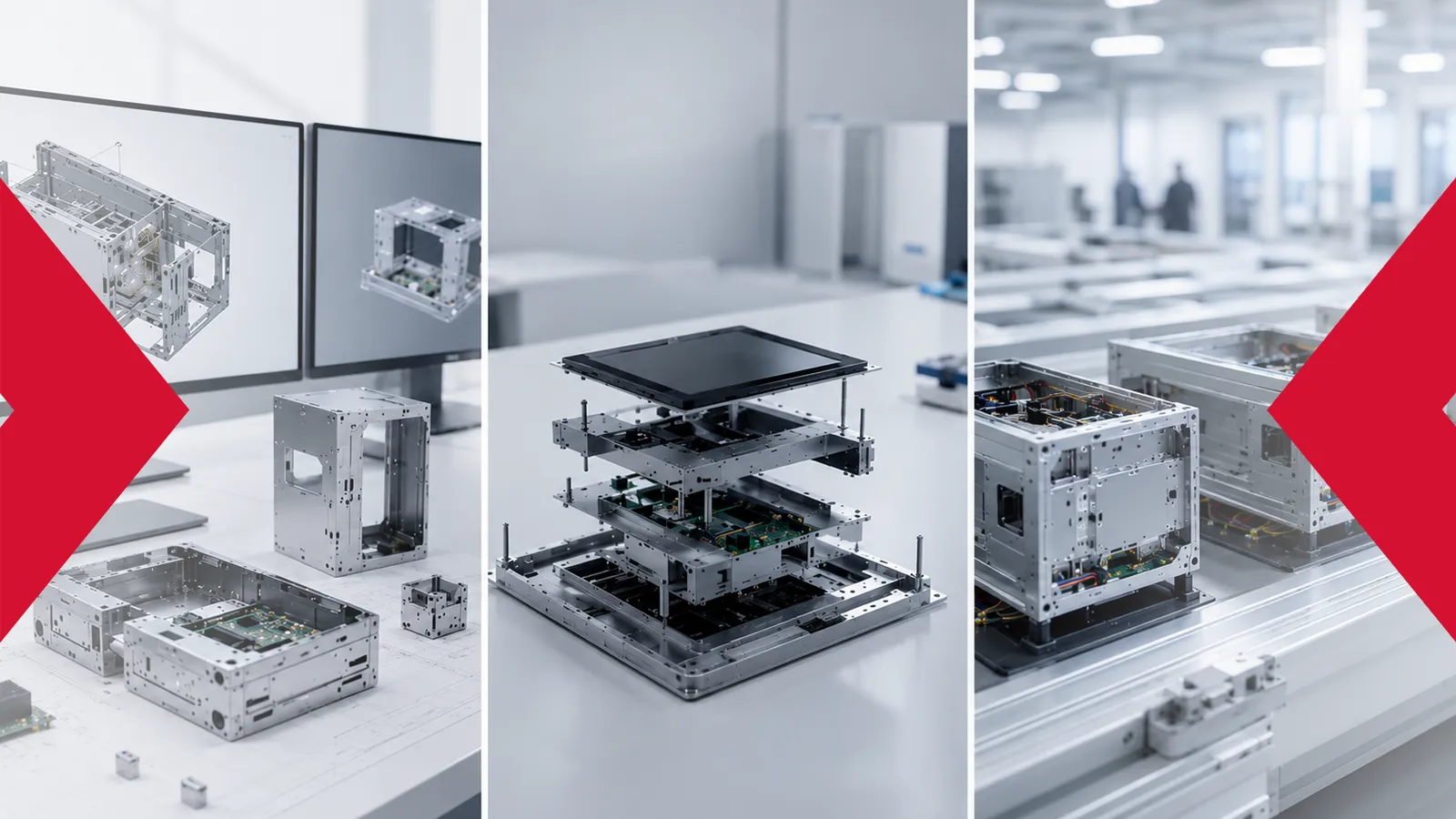
Concept visualization of the Design-for-Manufacturing process
Innovative solutions do not arise solely from good ideas or technical development. Especially with complex systems, success also depends on how efficiently a solution can be transferred into manufacturing, scaled, and adapted to specific customer requirements.
Within the Build-to-Run approach, ALMEX does not view manufacturing as a downstream step, but as a strategic component of the overall process. The service areas Consulting, Engineering, Manufacturing, and Services interlock, enabling end-to-end support from the initial idea through to later operation. For the Manufacturing phase, ALMEX has in-house production sites that offer key advantages. They enable shorter coordination paths, greater flexibility, and targeted selection of suitable manufacturing capabilities. The following article shows how in-house production sites can specifically accelerate the process from idea to operation.
Manufacturing as part of the Build-to-Run approach
In the Build-to-Run approach, manufacturing follows the Consulting and Engineering phases. At this point, technical drawings, development documentation, and finished prototypes are already available and serve as the basis for later production. The task of the Manufacturing phase is to turn these results into market-ready products. In doing so, manufacturing is not only considered after the development phase is complete; rather, in line with Design-for-Manufacturing logic, production requirements are incorporated into the development process at an early stage. This allows technical solutions to be designed so they can later be manufactured and scaled efficiently. This close integration of Engineering and Manufacturing reduces coordination effort and accelerates the transition from development to production.
ALMEX therefore develops products not only from a functional perspective: even during the development phase, manufacturing options and the cost-effective implementation of individual customer requirements are taken into account—creating an efficient process chain from idea to finished product.
The right production network for every requirement
Not every project places the same demands on manufacturing: some customers require customized special solutions in relatively small quantities, while other projects focus on high production volumes and the most cost-effective manufacturing possible. As part of the international TRI STAR Group, ALMEX can draw on a broadly positioned production network with diverse manufacturing capabilities in Germany, Europe, and Asia, enabling the right manufacturing strategy to be selected for each project.
Depending on project requirements, different production sites—such as Germany, Indonesia, Vietnam, or Poland—can be involved. Small series and customized special solutions can be implemented at sites in Germany, for example, while additional European or Asian manufacturing capacities are available for medium and high volumes. In addition to the planned quantity, factors such as technical specifications, available manufacturing capabilities, suitable sites, lead times, and cost-effectiveness also play a role. Thanks to its broad production network, ALMEX can find the optimal balance for each project between customization, efficient production, lead time, and cost-effectiveness.
The advantage of this approach is that manufacturing strategies and sites are not rigidly predefined. Instead, each project is assessed to determine which production sites and manufacturing capabilities best meet the requirements—enabling cost-effective implementation on the one hand and providing the necessary flexibility for individual customer requirements on the other.
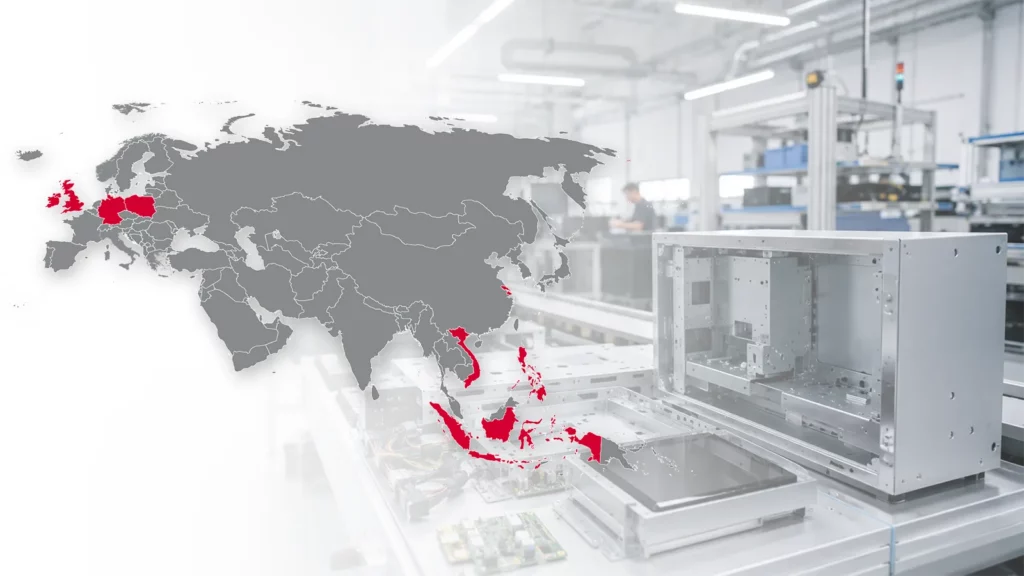
TRI STAR Group sites in Europe and Asia
How short paths accelerate implementation
A major advantage of in-house production sites is the close integration of development and manufacturing. Because manufacturing options are already known during the development phase, they can be considered from the outset. This reduces coordination effort between the individual project phases, and technical and commercial challenges related to production can often be clarified directly within the existing network. It also reduces the effort required to onboard new manufacturing partners, as established processes and interfaces are already in place.
This creates clear benefits for customers: new requirements can be implemented more efficiently and project workflows can be planned more reliably. Especially for complex projects, in-house production sites can be a real advantage in terms of the speed of production and manufacturing processes.
Practical example: Distributed manufacturing of ticket vending machines
How strategic manufacturing works in practice can be seen, for example, in the production of ticket vending machines for well-known customers in public transport. Depending on project requirements, the individual manufacturing steps are distributed across different sites. Core components can be manufactured where high volumes can be produced most cost-effectively, while the installation of customer-specific components—i.e., customization—and final testing take place closer to the target market of use. One basis for this is, among other things, the modular design of ALMEX systems, which enables targeted adaptation of individual components. Further insights on this topic are provided in the article “Sustainability and intelligent design by ALMEX”.
This approach enables a sensible combination of series production and customization. Standardized components can be produced efficiently, while new customer-specific requirements and European components are added only in later process steps. Components such as printers, payment systems, or cash handling can be integrated where they are available and where further assembly and final testing can be carried out most efficiently. This means certain European components do not first have to be shipped to a distant production site and then transported back again. In this way, ALMEX has delivered over 3,000 customized machines to various customers over the past three years.
Conclusion: Strategic manufacturing as an accelerator in the Build-to-Run process
Strategic manufacturing is more than simply producing a product. It is a central component of an end-to-end process from idea through to later operation and is closely integrated with the other phases of the Build-to-Run process. This allows manufacturing capabilities and production sites to be considered early and incorporated into development.
In-house and group-affiliated production sites create key advantages: they enable shorter coordination paths, a flexible response to different quantities, and cost-effective implementation of individual customer requirements. In addition, existing manufacturing capabilities within a production network can be deployed precisely where they create the greatest added value for the respective project. Strategic manufacturing not only accelerates the path from Engineering to production, but also strengthens the ability to implement complex projects and products efficiently and flexibly.