
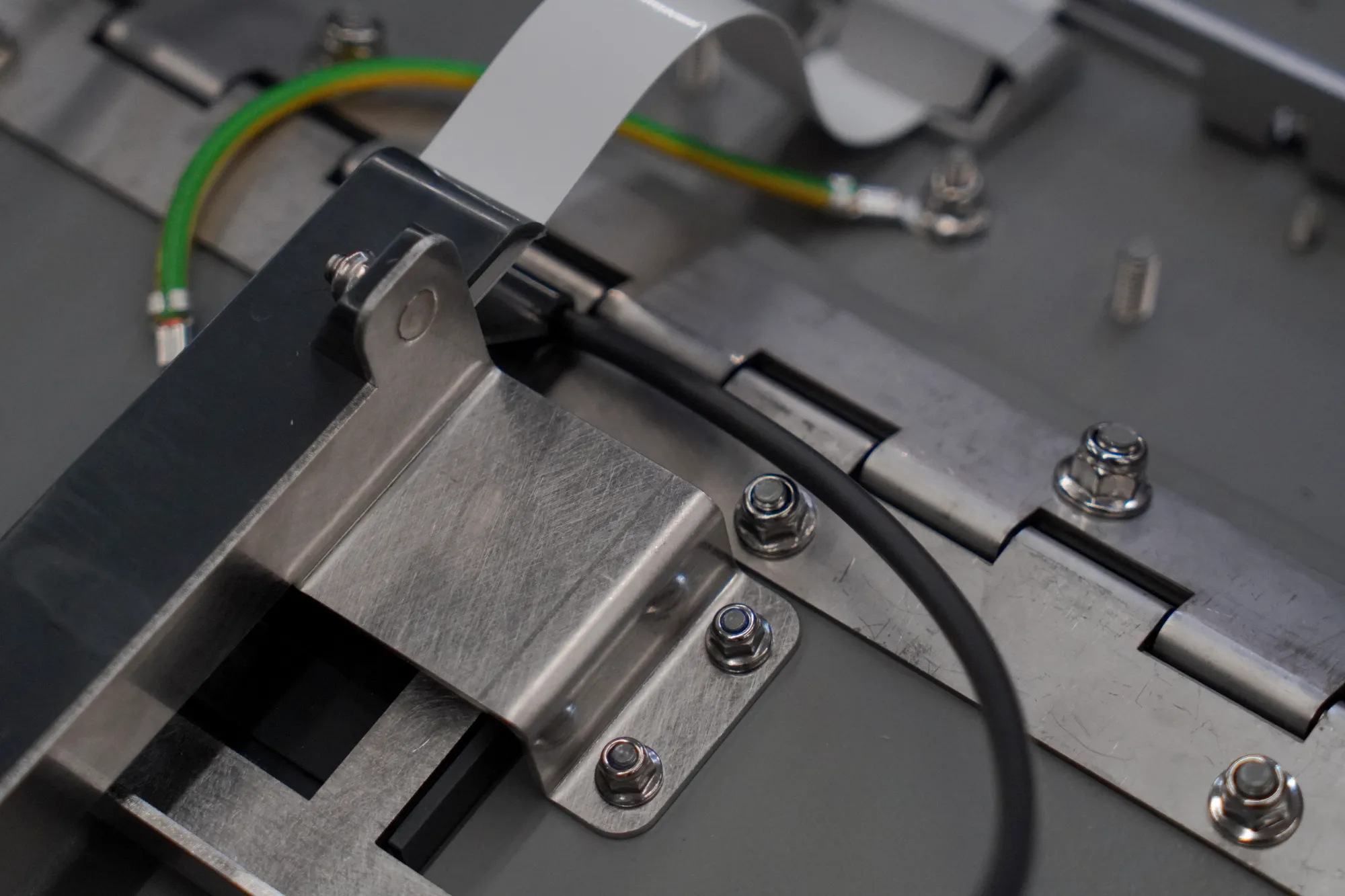
Detail from ticket machine assembly in Hanover
Sustainability is a guiding principle of resource use intended to ensure the long-term satisfaction of needs by preserving the natural regenerative capacity of the systems involved. Sustainable business practices are more relevant today than ever, and the technological environment is no exception. It is no longer solely about energy consumption or recycling, but increasingly about how products must be developed to function as durably, low-maintenance, efficiently, and resource-efficiently as possible during operation. Particularly in public transport, where systems are often in use for many years and must function reliably every day, sustainability and intelligent design are becoming increasingly important. The following article shows how ALMEX is meeting these challenges.
Sustainability begins in the development phase
To create sustainable solutions, sustainability must be considered from the very beginning. The foundations for ensuring that products can be produced and deployed in a resource-efficient manner and used long-term in public transport are already laid during the concept and development phase. To achieve this, ALMEX relies on intelligent design and modular system concepts at an early stage, ensuring that components remain easily accessible and replaceable. Printers, payment terminals, and other assemblies can thus be modernized or replaced relatively easily without having to replace the entire device. This approach not only reduces maintenance effort and associated downtime but also contributes to extending the overall product lifecycle.
As a modern innovation partner, ALMEX follows the so-called Build-to-Run approach, which encompasses the service areas of Consulting, Engineering, Manufacturing, and Services. The concept of sustainability runs through all process phases. Resource-efficient production alone is not enough if solutions are service- and resource-intensive during later operation or, in the worst case, have to be replaced after a short time – which is why the product lifecycle must be viewed holistically. Sustainability is integrated into every step of the Build-to-Run approach to ensure that systems can be operated reliably for many years and flexibly adapted to new requirements.
Modular systems extend the product lifecycle
A central key to the design of sustainable systems is modularity. Instead of having to replace devices completely in the event of defects or the need for modernization, individual components in modular systems can be specifically replaced or upgraded. This approach saves resources, reduces electronic waste, and enables more economical and, above all, more efficient long-term operation.
ALMEX follows an approach here in which assemblies are specifically designed to be interchangeable. Individual components can also be refurbished in the Repair Center instead of being disposed of directly. At the same time, the modular architecture allows existing devices to be easily adapted to new technical or regulatory requirements. If, for example, requirements for payment systems, printing technology, or legal regulations change, existing systems do not necessarily have to be completely replaced. Instead, targeted retrofits or upgrades can be carried out, which significantly extends the service life of the devices. Through this technical formula, systems can be operated for many years and flexibly expanded as required.
Robust material selection as a sustainability factor
In public transport in particular, ticket machines are often exposed to heavy use. Daily continuous use, temperature fluctuations, mechanical stress, and vandalism are part of the regular operating environment and affect the machines. To ensure long-term operation, systems must therefore feature resilient materials.
A particular example of this is the ALMEX mobile.cashless product family. During the development of these mobile ticket machines, a conscious decision was made to use robust steel housings and tempered glass. While competitors in comparable areas often rely on plastic solutions, ALMEX specifically pursues an approach designed for durability and resilience. The idea behind it: The robust construction reduces the need for replacement and also contributes to a long-term reduction in maintenance and service effort. These systems are already in use in various versions at different public transport companies. There, they support cashless ticket sales directly in the vehicle and simultaneously demonstrate how intelligent design and sustainable system development can be put into practice.
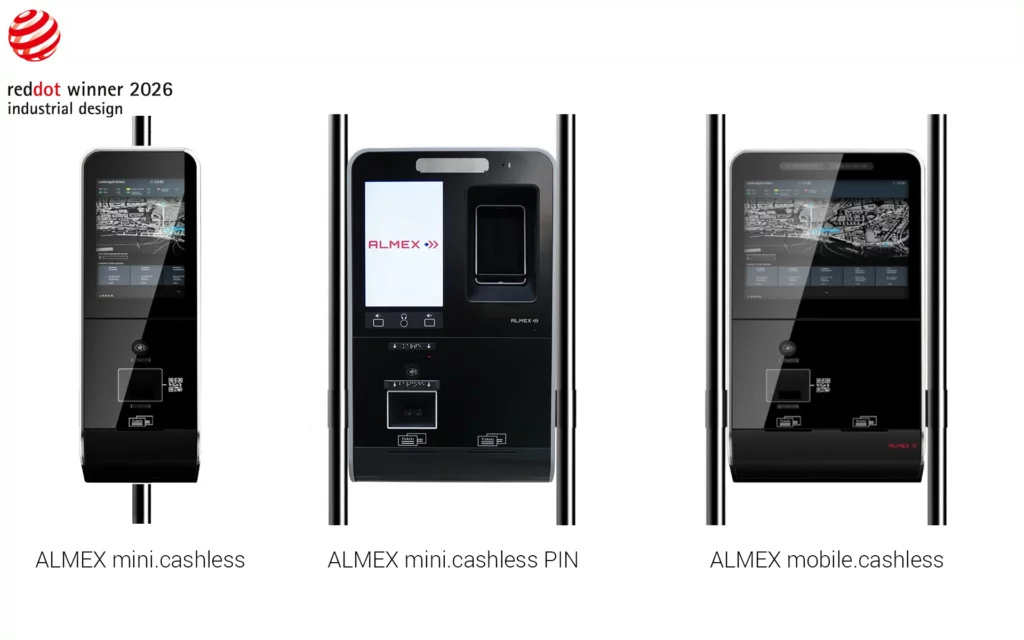
Illustration of the various machines in the ALMEX mobile.cashless family
Energy efficiency and intelligent system control
Particularly in mobile use within vehicles, systems must be developed so that they remain reliably available and also handle existing resources as efficiently as possible. Unlike stationary systems, only a limited on-board power supply is available in vehicles, which is why energy consumption and intelligent system control play a particularly important role here.
Against this background, ALMEX relies on modular solutions that can specifically reduce power consumption and continuous load. For this purpose, functions such as time-controlled activation, controlled shutdown, or automatic switching to energy-saving operating states are implemented, which contribute to using resources more efficiently and minimizing hardware stress. This controlled system operation additionally extends the service life of individual components as well as the overall system. In this context, sustainability therefore means not only lower energy consumption but also the longest and most stable use of technical systems possible.
Conclusion: Sustainability as a component of modern system development
At ALMEX, sustainability and intelligent design are part of a holistic development approach. In the context of the Build-to-Run approach, sustainability is considered in every step – from consulting and engineering to industrial manufacturing and services during ongoing operation – throughout the entire lifecycle of a system. The focus is on adaptable and sustainable solutions that can be operated economically in public transport over the long term. This is made possible by a modular system architecture that supports easy maintenance and upgrades, the use of robust materials, and intelligent system control. In this way, resources can be conserved and operating costs reduced at the same time.
Against the background of increasing requirements for economic efficiency and resource efficiency, intelligent design will continue to gain importance in the future. ALMEX therefore aims to further expand sustainable system development as an integral part of modern technology solutions.