

Without software, a machine would ultimately be just metal and plastic. Especially with modern machine and system solutions, software is an important component that often receives too little attention alongside the directly visible hardware. It often operates in the background but is crucial in determining whether a system remains reliable and connected in everyday use. Whether user interface, payment processing, or subsequent maintenance: Many central functions of modern systems only emerge through the interaction of hardware and software.
With the increasing development of artificial intelligence, the possibilities in the development and operation of technical systems are also expanding. AI can accelerate development processes, structure requirements, support error analysis, and, in the long term, enable new forms of interaction between humans and machines. Artificial intelligence thus plays an increasingly important role in both development and potential product applications. At the same time, its use also places high demands on quality, security, data protection, and technical control.
Within the Build-to-Run approach, which describes the holistic process from consulting through engineering and manufacturing to services in later operation, ALMEX considers software and AI as an integral part of holistic system development. From requirements analysis to later operation, digital functions must be conceived in such a way that they remain reliable, controllable, and practical. This article shows in detail what role software and AI play in this context and what possibilities arise for digital solutions in public transport.
Why Software is the Foundation of Modern System Solutions
It is only through software that many functions become possible, which later appear self-evident in operation. User interfaces must function intuitively, all modules must interact seamlessly, and interfaces to external systems must work reliably. Especially in public transport, these requirements are particularly diverse. Sales systems must consider different tariff structures, payment methods, backend systems, and customer specifications, in addition to requirements for accessibility, data security, and maintainability. Software is therefore not just a technical detail, but a central system foundation for digital applications in public transport.
For ALMEX, this means: Hardware, interfaces, and subsequent service processes must be considered during the conception and engineering phase to be meaningfully linked.
AI as a Tool in Software Development
In addition to its numerous other application areas, artificial intelligence is also gaining increasing importance in everyday software development. Here, AI is used as an additional tool that makes individual work steps more efficient. This includes support in troubleshooting, code analysis, and the creation of technical documentation. AI can also provide support in upstream processes, for example, in the analysis of requirements or the evaluation of tenders. This can be particularly relevant for customer-specific projects, as these often involve complex and extensive requirements. Artificial intelligence can help to capture and process information more quickly.
At the same time, its use remains clearly limited: AI output can seem plausible but still be technically incorrect. Therefore, results are never adopted unchecked but are evaluated, tested, and integrated into existing processes by experienced developers. The technical evaluation and final decision remain entirely with the development team.
AI in Products and Customer Solutions
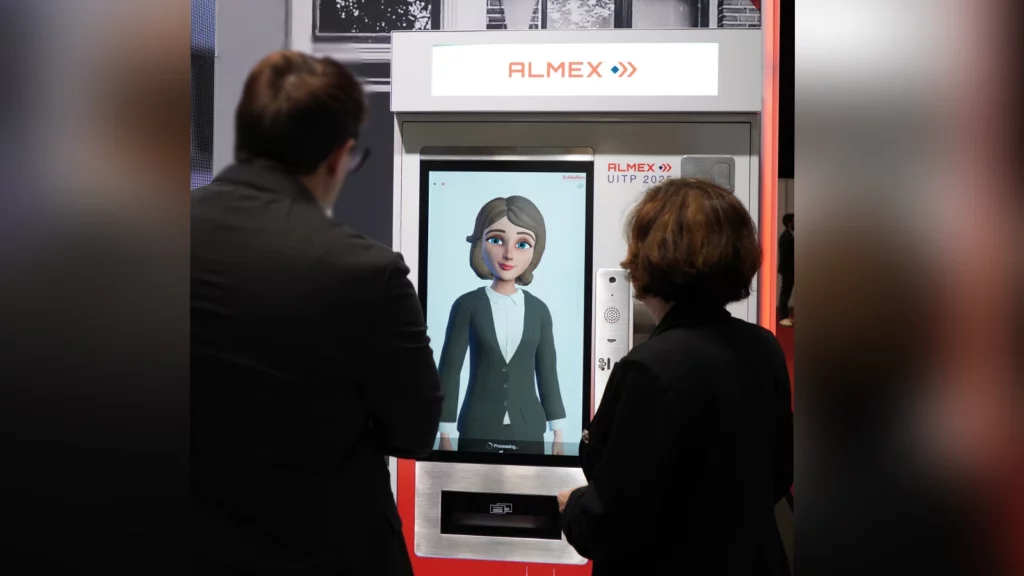
In addition to the internal use of artificial intelligence in software development, AI also opens up new possibilities for products and customer solutions. A clear example of this is an AI-powered Travel Assistant integrated into ticket machines. While a simple voice control primarily recognizes predefined commands, the intelligent assistant goes a step further: It tries to understand the intent behind a query and specifically asks for missing information. A classic system might not be able to do much with statements like “I want to go out for dinner tonight” because no clear destination stop was mentioned. An AI-powered assistant, however, can ask intelligent follow-up questions, such as: What kind of restaurant are you looking for? In which area should it be located? When would you like to be there? Is another person traveling with you? Based on this information, the system can search for a suitable connection, select the correct tariff option, and add the ticket to the shopping cart.
In practice, these possibilities can help simplify operating procedures for passengers in public transport and relieve service processes. The machine would thus become more of a digital service assistant, supporting passengers even with complex questions and individually. Especially in public transport, this can be helpful, as not every passenger knows tariff zones, stops, or ticket options precisely. Passengers’ needs for explanation could be addressed directly at the machine.
However, such AI systems must be carefully developed. An AI demonstrator at a trade fair is different from a freely accessible system in daily operation. In later use, data protection, regulatory requirements, cost-benefit considerations, and technical limits must be taken into account – for ALMEX, the potential for this reason lies not only in the AI function itself, but in its controlled integration into practical and long-term operable systems.
Conclusion: Software and AI as Building Blocks for Future-Proof Systems
Software is now a central component of every modern machine and system solution. It connects hardware components into a functioning overall system and enables operation, data processing, and service processes. Artificial intelligence expands these possibilities: AI can, on the one hand, accelerate software development processes and, on the other hand, prospectively enable new forms of interaction between humans and machines.
Within the Build-to-Run approach, ALMEX therefore combines software expertise with AI-supported development, resulting in solutions that are both technically innovative and reliably operable in the long term.