
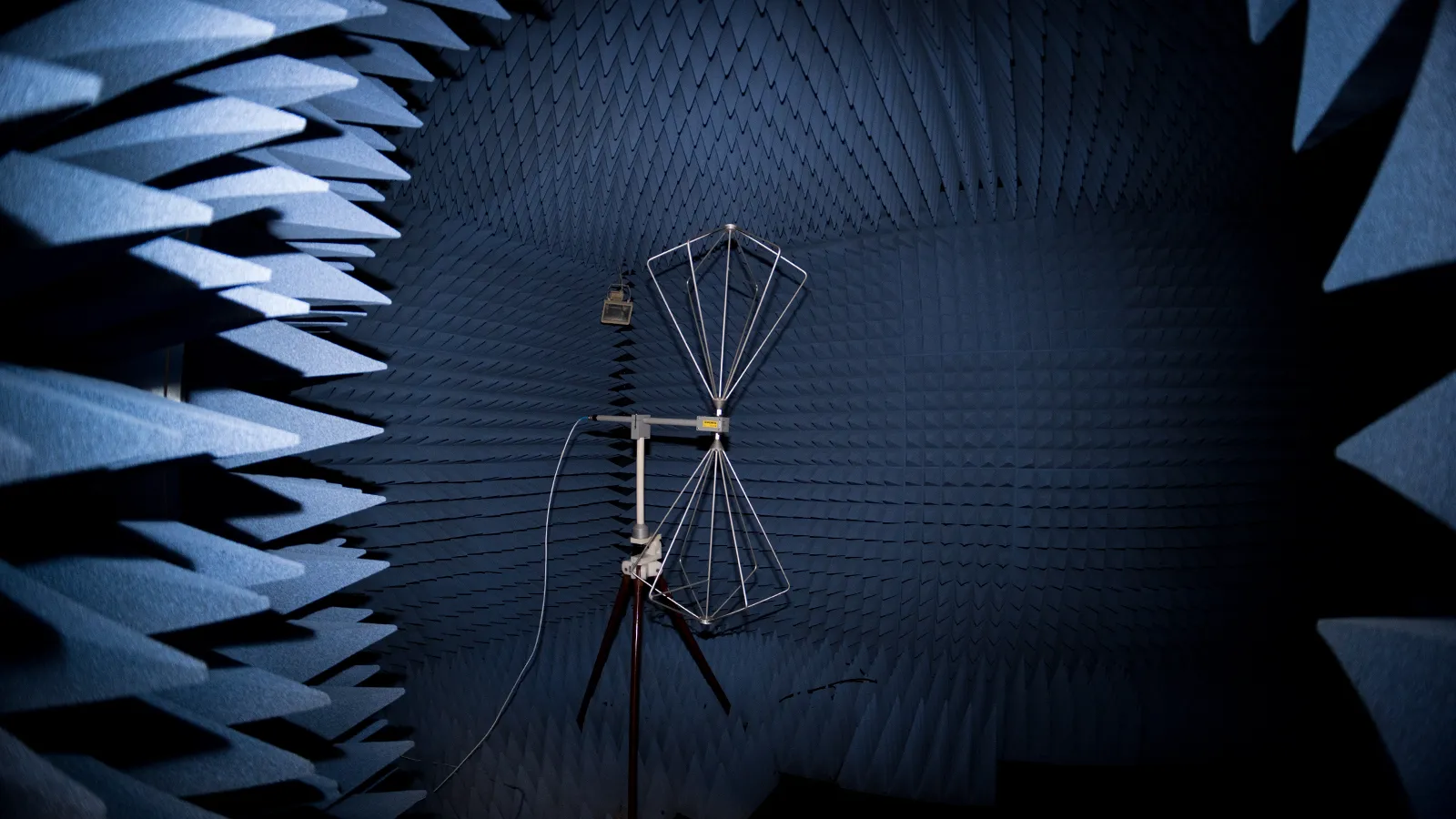
Interior view of the EMC chamber at the ALMEX site in Hanover
Wherever electronic components such as communication interfaces, power supply units or other technical systems interact in a confined space, electromagnetic compatibility plays an important role. Because interference can not only impair the functions of individual components, but in the worst case also affect the operation of entire systems.
For companies developing complex technical solutions, electromagnetic compatibility – or EMC for short – is therefore not a topic that only becomes relevant shortly before final testing. EMC should already be taken into account during the technical development of products or systems so that potential sources of interference can be identified early and suitable technical measures can be implemented. As part of the Build-to-Run approach, which describes the end-to-end process from consulting and engineering to manufacturing and later services in ongoing operations, ALMEX considers electromagnetic compatibility an integral part of system development. The EMC chamber enables development-accompanying investigations and helps to better prepare products for later real-world use. Why EMC is so important for technical systems and what service ALMEX’s in-house EMC chamber provides is shown in the following article.
EMC as the basis for reliable technical systems
Electromagnetic compatibility refers to the ability of an electrical or electronic system to function reliably in its intended environment—without interfering with other devices or being impaired by electromagnetic influences itself. For modern vending machine and system solutions, EMC is therefore a key factor for smooth operation.
Especially within complex technical devices, many components are installed in a confined space: displays, printers, payment systems, power supplies, communication modules, control units, interfaces, etc. must work together without negatively affecting each other. In addition, there are external influences from the respective environments, for example in public spaces or in vehicles. If EMC is only considered shortly before final testing, potential sources of interference become visible late. Adjustments are then often more time-consuming and expensive because the system components have already largely been defined. If, on the other hand, EMC is taken into account early in development, risks can be assessed more effectively and technical solutions can be optimized early on to ensure stable operation. EMC is therefore not an isolated test step at the end of a project, but an integral part of professional system development.
The EMC chamber as development-accompanying infrastructure
At its Hanover site, ALMEX has its own 3 m EMC measurement hall available, which can be used for development-accompanying EMC investigations. This allows technical anomalies to be analyzed in a targeted manner and necessary adjustments to be made more quickly.
In the EMC chamber, radiated emissions can be investigated, among other things. This involves checking which electromagnetic emissions a device releases into its environment. This is particularly relevant for devices in which various components work together in a compact space. The “3 m” in 3 m EMC measurement hall refers to the height of the EMC measurement hall. In the chamber, radiated emissions in the range from 30 MHz to 6 GHz can be investigated, among other things. In addition, conducted emissions can also be considered, for example at DC, AC or Ethernet interfaces. In addition, selected test options for electrostatic discharges as well as certain automotive immunity tests are available.
In the Build-to-Run process, the EMC chamber primarily supports the link between engineering, manufacturing and real-world operation. Technical risks can be identified early and products can be better prepared for their later operating environment. This can relate, for example, to the arrangement of individual components, cable routing, shielding or interfaces within the devices. It is important to note: The EMC chamber is not to be understood as an accredited test laboratory, but as an internal infrastructure for development-accompanying investigations, troubleshooting and pre-qualification.

Pyramidal absorbers inside the EMC chamber at the ALMEX site in Hanover
Practical example: EMC at ALMEX cashless
How important electromagnetic compatibility is for compact system solutions is clearly shown by the example of ALMEX cashless. Here, electronic and electromechanical components are placed in a confined space and must work together reliably in later operation. These include, among other things, the display, payment terminal, printer, power supply and interfaces. Especially with such integrated solutions, it is not sufficient to look at the individual assemblies in isolation, because what matters is the interaction of all components in the overall system.
In addition, ALMEX cashless was developed for use in public transport. Therefore, the system must not only be functionally convincing, but also operate reliably under real operating conditions. This includes different environments, because the devices may later be exposed to various external influences at train stations, stops or near vehicles. For ALMEX cashless, this means: The system must be designed so that it also functions stably in such real environments and is not impaired by external influences—this is ensured in the EMC chamber at the Hanover site.
Conclusion: Consider EMC early on
Especially with complex vending machine and system solutions, it is not only the performance of individual components that matters, but above all their interaction in later operation. To identify sources of interference and technical risks early and to be able to make adjustments quickly and efficiently, EMC aspects must be considered from the very beginning. With its own EMC chamber at the Hanover site, ALMEX has an important internal infrastructure for investigating products alongside development and optimizing them for later use. This makes electromagnetic compatibility an integral part of the Build-to-Run process.